
Landlords in Highbury, Barnsbury and five more wards need an £850 council licence from 23 November. Who is covered, what it costs and how renters can check.
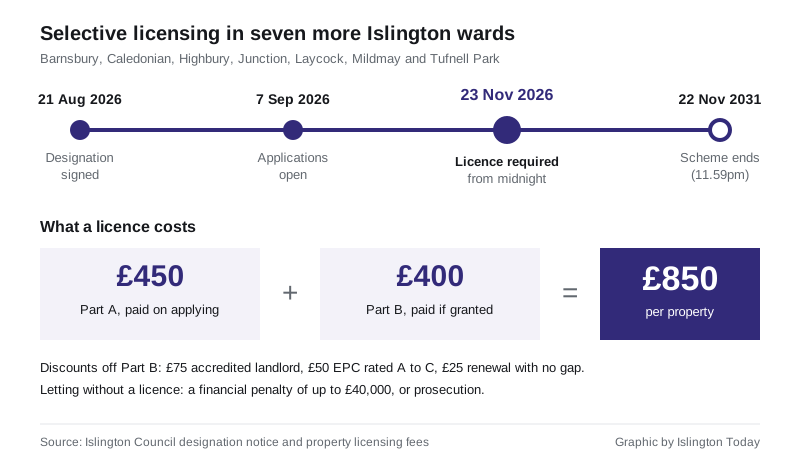
Private landlords in seven more Islington wards will need a council licence to let a home from 23 November. Letting without one becomes a criminal offence from that date. Applications opened on 7 September, the council said.
The new area covers these wards:
- Barnsbury
- Caledonian
- Highbury
- Junction
- Laycock
- Mildmay
- Tufnell Park
The same scheme has run since 2024 in Finsbury Park, Hillrise and Tollington, and that designation stays in force. The new one was signed on 21 August 2026. It takes effect at midnight on 23 November and runs until 11.59pm on 22 November 2031, according to the legal notice.
Which homes need a licence
The scheme covers privately rented homes in the seven wards let to:
- one person
- two people sharing, whether or not they are related
- a single household or family, of any size
It does not cover homes in multiple occupation, which already need a separate licence across the whole borough. Nor does it cover owner-occupied homes, or council and housing association homes. Those exclusions are set out in paragraph 6 of the designation notice.
What it costs a landlord
A selective licence costs £850 for the whole property, paid in two parts, the council’s fee schedule shows.
| Payment | Amount | When |
|---|---|---|
| Part A | £450 | On applying, to cover processing |
| Part B | £400 | Only if the licence is granted |
| Total | £850 | Per property |
Three discounts come off Part B, and they can be added together:
- £75 for a landlord accredited by an approved body such as the London Landlord Accreditation Scheme or the NRLA
- £50 if the property has an EPC rating of A, B or C
- £25 for a renewal with no gap between licences
Fees are not refunded once an application is in, even if the property is later sold. A licence lasts up to five years, and the council can issue a shorter one if it finds a home was let unlicensed beforehand. Each property needs its own application. The how to apply page lists the documents needed, including a gas safety certificate, an electrical installation condition report, the tenancy agreement, floor plans and the EPC.
What happens to landlords who do not apply
Letting an unlicensed home in the area is an offence under section 95 of the Housing Act 2004. The council says it can:
- prosecute, with an unlimited fine on conviction
- impose a financial penalty of up to £40,000 for each offence, against each person responsible
- apply for a Rent Repayment Order, which makes a landlord pay back up to 12 months’ rent
Those powers are set out on the council’s property licensing page. Breaching a licence condition is a separate offence.
Why these seven wards, and not nine
The council’s Executive agreed the expansion on 23 October 2025. Its report sets out the case. Around a third of Islington’s homes are privately rented, housing over 74,000 residents, including more than 4,600 children and young people.
The report also found:
- 3,100 private rented homes are likely to have at least one Category 1 or high-scoring Category 2 hazard
- the council logged 1,886 complaints and service requests about 1,719 private rented properties over five years
- more than a fifth of applications under the existing scheme were missing certificates that landlords are already legally required to hold
The report says the change would bring another 14,000 homes under regulation.
The council consulted on nine wards, from 13 January to 13 April 2025, and received 1,081 responses. Support was almost identical in every ward, with 46 to 47% agreeing and 18 to 20% disagreeing. Landlords and agents were the most opposed: 88% of them disagreed with the selective licence fee.
Canonbury and Clerkenwell were held back. The report says a detailed response about property conditions in Clerkenwell led officers to do “further detailed profiling” before making a final recommendation for those two wards. Landlords there are not covered by the new designation.
“Islington is a popular place to rent with nearly a third of homes in Islington privately rented,” said Cllr Jason Jackson, the council’s executive member for homes and neighbourhoods. He said the schemes target “areas where renters are most vulnerable”.
What it means for you
If you rent privately in one of the seven wards, you can check whether your landlord has applied on the council’s public licence register. A licence comes with conditions on safety, repairs, security, waste and the information tenants must be given. Tenants have used Rent Repayment Orders before. The Executive report cites figures from Justice for Tenants: £324,000 recovered for Islington tenants over five years for housing and licensing offences.
If you are a landlord or agent, apply before 23 November. From that date an unlicensed let is an offence. Applications are made online through the property licensing portal, and you need a landlord account first.
If you are not sure your street is in one of the wards, the designation includes a map. The Property Licensing Team will also confirm it: email property.licensing@islington.gov.uk or call 020 7527 7670, 9am to 5pm, Monday to Friday.
For the wider picture on what homes cost in the borough, see our Islington house prices page.
Sources
- The London Borough of Islington Designation of an Area for Selective Licensing 2026, Islington Council, 21 August 2026
- Property licensing, Islington Council
- How to apply for a property licence in Islington, Islington Council
- Property licensing fees, Islington Council
- Discretionary Property Licensing: Improving our Private Rented Sector, report to the Executive, 23 October 2025
- Stronger protection for thousands of renters this autumn, Islington Council, 7 September 2026
Have your say