
Islington Council took 5,144 complaints in 2025/26, up 52%, and paid £1.122m in compensation. Three in four were about housing; delays top the list.
Complaints to Islington Council rose by more than half last year, and the council paid out £1.122 million in compensation. Almost all of that money went to council tenants and leaseholders.
The figures are in the council’s annual complaints report for 2025/26. It goes to the Overview and Scrutiny Committee on Thursday 8 October at 7pm.
The numbers
Between April 2025 and March 2026 the council received:
- 5,144 Stage 1 complaints, up 52.1% from 3,382 the year before
- 1,464 Stage 2 complaints, where a resident asks for a review, up 85.3% from 790
- 144 Housing Ombudsman investigations, up from 37
- 26 Local Government and Social Care Ombudsman investigations, up from 8
The Homes and Neighbourhoods directorate, which runs council housing, took 76.2% of all Stage 1 complaints (3,922). The next biggest was Environment and Climate Change, with 487. That department’s total more than doubled from 216.
Just over half of Stage 1 complaints, 52.1%, were upheld in full or in part. The report says that means the council “had not met the expected standard of service in just over half of cases”. It puts Camden and Hackney at 55% for 2024/25.
What people complained about
Delay was the biggest single reason, behind 948 Stage 1 complaints (37%). Poor communication came next with 721, then “failure to do something” with 421.
Inside housing, delay was even more dominant: 1,859 complaints, or 45% of the directorate’s Stage 1 total. Repairs generated the most escalations by far, with 398 Stage 2 complaints. Homelessness was next with 70, then Housing Options with 67.
The report also notes a newer pattern. It says more complaints are being written by residents “using AI technologies to refer to policies and legislation”, and by third parties offering to complain for residents “to try and derive compensation payments”. It gives no figure for either.
What it cost
The report puts the bill in two parts:
- £1.122m paid in compensation: £1.044m from the Housing Revenue Account, which is funded by council rents, and £78,000 from the general fund
- £3.941m on staff handling complaints: £2.9m of budgeted posts plus a £1.041m overspend
The Housing Ombudsman’s view
The Housing Ombudsman’s own landlord report on Islington is attached to the papers. It covers the council’s 34,618 homes and the same twelve months.
In 2025/26 the Ombudsman:
- received 428 cases about Islington, of which 146 were formally accepted (“duly made”)
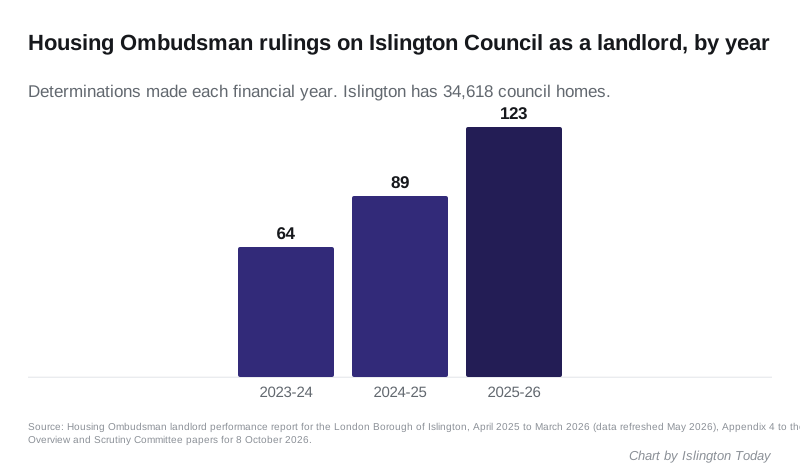
- made 123 determinations, up from 89 the year before and 64 the year before that
- made 164 findings of maladministration or service failure, five of them severe maladministration
- issued 353 orders and 85 recommendations
- ordered £83,986 in compensation
The share of findings that went against the council has fallen. The Ombudsman’s maladministration rate for Islington was 65% in 2025/26, against 75% in 2024/25 and 82% in 2023/24. The council’s report calls its own figure of 64.6% provisional and says the data is still being verified.
The council says it complied with every Housing Ombudsman order. The most common subjects of rulings were repairs, damp and mould, leaks, anti-social behaviour and complaint handling.
The Local Government and Social Care Ombudsman, which covers councils’ other services, investigated 30 of the 153 complaints it received about Islington. The report counts 27 of them as upheld. In six of those, the Ombudsman found the council had already offered a fair remedy.
Response times
The Ombudsmen’s complaint handling code gives councils 10 working days to answer a Stage 1 complaint, or 20 with an authorised extension.
The report says 57.6% of Stage 1 complaints were answered within 10 working days. A further 30.9% were answered within an extension, most of them in housing.
Councillors’ own casework was slower. Between July 2025 and March 2026 the council received 3,021 enquiries from councillors and 881 from MPs. Only 55.5% of the councillor enquiries were answered within 10 working days, although that rose to 76.3% in the final quarter.
What the council says has improved
The report lists changes it says came out of complaints:
- routine repairs completed rose from about 55% in the first quarter to 85% by the fourth
- upheld complaints about delays to damp and mould work fell to zero by the fourth quarter
- the wait for a homelessness enquiry appointment fell from about three weeks to two days
It says the next year will focus on a new operating model, fewer extensions and a central team for councillor and MP casework.
What it means for you
If you have a complaint about a council service, the process has two stages. Stage 1 is answered by the service itself. If you are unhappy with the answer, you can ask for Stage 2, a review by the council’s central complaints team.
Council tenants and leaseholders can then go to the Housing Ombudsman. For other council services, the route is the Local Government and Social Care Ombudsman. The report says either Ombudsman can be contacted at any time, but a formal investigation only starts once both council stages are finished. Complaints to the Local Government Ombudsman usually have to be made within 12 months.
The Overview and Scrutiny Committee meets at 7pm on Thursday 8 October at the Town Hall on Upper Street. The agenda and papers are online, and the meeting is held in public.
Related: Council tax bands in Islington and our earlier report on an Ombudsman ruling over a direct payment account.
Sources
- Annual Complaints and Members Enquiries performance report 2025-2026, report of the Executive Member for Finance to the Overview and Scrutiny Committee, 8 October 2026.
- Housing Ombudsman landlord performance report, London Borough of Islington, April 2025 to March 2026, Appendix 4 to the same report.
- Overview and Scrutiny Committee, 8 October 2026: agenda.
A note on the figures: the council’s report is not consistent with itself in places. Its summary gives 1,468 Stage 2 complaints where the body and Table 1 give 1,464, and its directorate table gives last year’s Stage 1 total as 3,668 against 3,382 elsewhere. We have used the figures from the report’s main tables and named where each one comes from.
Have your say